Part II of V · The technical companionA rigorous treatment
Bounded Continuity
How one timeless quantum state parses into many bounded subjects, the mechanism, the boundary, and the experiment that would prove it wrong.
Plain-language essay → The Weave and the Window
Part I
Decombination & the boundary
I.1 · The problem
A state with no built-in parts
The substrate is a single global quantum state |Ψ⟩ in a large Hilbert space H, timeless and without built-in spatial structure. To speak of “a part” of it is to choose a factorization H ≅ H₁ ⊗ … ⊗ H_n, and the same state admits enormously many inequivalent factorizations: the tensor-product-structure ambiguity. There is no fact about which degrees of freedom belong to which system before a factorization is chosen. Decombination is the selection of a factorization, not the breaking of a pre-existing seam.
I.2 · The selected factorization
The same cut that makes spacetime
Almost every factorization is useless: under a generic one, every factor is near-maximally mixed and nothing stable exists. The realized factorization is selected by quasiclassicality / minimal non-locality: the cut under which the dynamics is as local and simple as possible, admitting einselection of stable pointer states. This is the same selection that recovers geometry: in holographic and tensor-network settings, mutual information helps reconstruct distance and locality, with stronger correlations often corresponding to shorter emergent distance (Ryu–Takayanagi, holographic reconstruction). This holds in those restricted models, not for entanglement in general, which can be long-range, topological, or non-geometric. Space, time, and the partition into subjects would then be one emergence rather than three, provided minimal non-locality really picks the realized factorization. That is a conjecture, not a theorem.
It is worth sorting the physics into three tiers, so the reader can see exactly where the load shifts from established result to the theory's own extension, and never feels metaphysics smuggled in under physics.
Entanglement is real; to speak of subsystems at all requires a choice of factorization; decoherence and einselection help explain quasiclassical structure; and in certain holographic / tensor-network settings, entanglement is related to geometry.
Spacetime may emerge from entanglement or correlation structure; minimal non-locality may select a privileged factorization; mutual information may encode emergent distance. These are live research directions in restricted models, not settled facts.
The same factorization that yields spatial locality also yields subject-boundaries; consciousness is the interior of connectedness; mystical unity is the apprehension of that substrate. This is the theory's own extension — and it is the line where physics stops.
I.3 · What the theory does not claim
Why decoherence is not an objection
The standard refutation of “quantum mind” proposals is decoherence: the warm, wet brain destroys quantum coherence in femtoseconds (Tegmark), so the brain cannot be a macroscopic quantum object. This theory is untouched by that argument, because it never claims the brain sustains coherence. The fundamental quantum description belongs to the substrate; consciousness is constitutive of that substrate everywhere. The brain’s role is not to generate experience through fragile quantum effects but to bound an already-conscious substrate into a finite point of view.
So the brain–substrate relation is an isomorphism, not an identity of physical scale: the mathematics that governs how the universal state factorizes into integrated-yet-bounded parts is structurally the same mathematics that governs integration and segregation in neural networks. The claim is a scale-free correspondence of structure, in the spirit of the critical-brain literature, where the same balance of integration and segregation recurs across scales.
The brain, on this account, need not be a quantum computer; it need only be a boundary, and boundaries are classical, structural, and robust to decoherence.
This comes at a cost: an isomorphism, taken alone, is only an analogy, and an analogy does not establish that one’s consciousness is the universal consciousness, localized. The theory addresses this by locating the identity at the substrate level (the inversion above) and assigning the brain the strictly weaker job of parsing. Decoherence is not an objection, because the brain is asked to do less.
I.4 · The boundary
Subjects as bounded modules: the Markov blanket
Fix a quasiclassical factorization and encode its entanglement structure as a weighted graph: nodes are elementary factors, edge weights are the quantum mutual information I(i:j) = S(ρᵢ) + S(ρⱼ) − S(ρᵢⱼ). A subject is a subset S that is strongly integrated within and weakly coupled without. The outward coupling is the boundary openness O(S) = I(S : E), the mutual information crossing the cut to the complement E — the information that leaks between the subject and the rest, so it rises as the boundary opens and falls toward zero as the subject seals off (its inverse is the boundary’s segregation, or closure).
Earlier statements of this theory defined the boundary through integrated information alone. That metric is heavily contested, which made the framework fragile. The boundary is therefore recast in terms of a Markov blanket: the statistical screen that renders a system’s internal states conditionally independent of its environment, given the blanket. A subject is a region wrapped in such a blanket, and O(S) reads that boundary’s openness — how much information still crosses it — off the mutual-information graph. Strictly, this is a Markov-blanket-inspired proxy: low O(S) is necessary for a blanket but not sufficient, since a genuine blanket is a conditional-independence screen, not merely low cross-boundary information. The build supplement makes that caveat explicit and computable.
This is a supplement, not a clean replacement. A Markov blanket gives a widely-used account of where the boundary is, but it does not by itself say which of many nested blankets is “the subject,” nor solve the binding problem. So a measure of integration (how unified the interior is) is retained alongside the blanket to mark whether a single subject is present at all, though both integrated information and the free-energy formalism that motivates Markov blankets remain contested.
I.5 · Why the boundary exists
Separation as metabolic necessity
If the ground is one connected whole, why would evolution build minds that feel isolated? The answer follows from the same formalism. Under the free energy principle, any system that persists against entropy must maintain a Markov blanket: it must act as though it is a bounded thing modelling a separate world. Maintaining a highly integrated interior is metabolically expensive, and treating the environment as external and resource-bearing is what lets a finite module hold itself together long enough to survive. The idea is older than the formalism. Spinoza’s conatus, the striving by which each finite thing persists in its own being, is the same boundary stated three centuries earlier: to be a finite thing is just to maintain the effort that holds it apart from everything else. The free energy principle gives that striving a measure.
Separation, on this view, is an achievement: an energetically costly algorithm that enables persistence. It is no illusion, in the dismissive sense. Felt continuity, the experience of oneness, is then simply what occurs when that survival-driven boundary algorithm is temporarily relaxed, and the interior’s connection to the whole is apprehended directly.
If a blanket is what persistence requires, then evolution is the process that builds and elaborates blankets: in these terms, the engine of the parsing itself. Natural selection keeps whatever persists, and to persist is to maintain a boundary, so life is the substrate carving progressively more elaborate, more integrated windows out of itself. The same selection that thickens the boundary, building a richer model of self against world, also builds the bridges across it: the senses, then signals, eventually language, by which parsed vantages re-find one another. Two cautions. None of this is a ladder aimed at humanity. A bacterium is a shallow window, not a failed one, and the deepening holds along some lineages only, never as a law. And there is no purpose in it. Selection raises boundary-and-integration capacity because persistence demands it, with no aim implied. Whether the parsing is trying to deepen is the bracketed question, left to the reader. None of this is a new prediction. It is the theory and established biology describing one process in two vocabularies.
I.6 · Persistence, death, dissolution
Felt continuity as a boundary thinning
A subject endures as long as its boundary holds and its interior stays integrated. The states of profound experience are those where O(S) rises (the boundary thins, so more information crosses it) while integration is preserved: the module is still a subject, but its edge with the whole is dissolving, and that is what it apprehends from the inside. Full recombination, at death, is the blanket no longer being maintained: the perspective rejoins the substrate. The experiential variable is thereby tied to a measurable structural quantity.
Part II
The empirical test
II.1 · From mechanism to measurement
Two proxies
Felt continuity is the inside of rising boundary openness O(S) at preserved integration. In a brain, boundary openness maps to functional network de-segregation (cross-network coupling) — its inverse, segregation, is the sealed boundary — and integration maps to a complexity proxy: the perturbational complexity index (PCI) and signal-diversity measures (Lempel–Ziv), which stay high in waking and are elevated by serotonergic psychedelics. The phenomenal variable is restricted to the unity / boundary dimension specifically (ego-dissolution and oceanic-boundlessness scales).
II.2 · The target network
The default mode network as the top-level blanket
“Modularity” alone is too coarse to test, so the claim is pinned to specific anatomy. The autobiographical self is maintained chiefly by the default mode network (DMN), treated here as a leading proxy for the brain’s high-level self-boundary — a central component of the self-model, not literally a full Markov blanket by itself, which is almost certainly distributed across the DMN, salience and frontoparietal-control networks, interoception, and thalamocortical dynamics. Felt continuity should therefore track the disintegration of the DMN specifically, together with increased cross-network coupling into sensory and limbic systems: the interior’s blanket thinning while the rest of the brain becomes globally connected. A diffuse, whole-brain change that spares the DMN should not produce the experience.
II.3 · Cross-route screening-off
The same function, whatever the cause
Because felt continuity is the apprehension of boundary loss as such, the relationship between DMN de-segregation and reported unity should be the same function regardless of how it was induced: psilocybin (via 5-HT2A), meditation, sensory deprivation, or hypoxia. In mediation terms, conditioning on the de-segregation should screen off the route: pharmacology matters only insofar as it thins the blanket.
route → DMN de-segregation → unity, with no direct route–unity path once de-segregation is fixed.
a route retains a direct effect on unity after conditioning on DMN de-segregation, or the slopes differ by route.
II.4 · The phase space
Why two kinds of “oneness” differ
The sharpest commitment is a conjunction, and it explains why the dissolution of a high-dose psychedelic feels nothing like the oblivion of dreamless sleep, though both lower the brain’s boundaries. Unity requires the boundary’s segregation to fall — equivalently, boundary openness O(S) to rise — and a subject to remain.
Both right-hand cells dissolve the boundary, but only the upper-right, with complexity preserved, yields a reportable experience. Psychedelic oneness sits top-right; dreamless sleep sits bottom-right: structurally distinct, not two flavours of one state.
intense lucid unity occurs in, and only in, the high-PCI / dissolved-boundary cell.
lucid unity is reported with the DMN intact; or DMN dissolution at preserved complexity reliably yields no unity; or unity tracks low complexity.
Part III
Toward a formal model
III.1 · The toy model, built
A few qubits, parsed
Earlier statements used mathematics conceptually. This one is implemented. The mini-universe is eight qubits arranged as two four-site Heisenberg rings (a subject S and an environment E) joined by bonds whose strength is a single tunable boundary parameter g. Each ring is a closed shell (a unique singlet when isolated), so a fully sealed subject carries zero cross-boundary information. As g is dialed, one reads off the boundary openness O(S) = I(S:E) (the information crossing the cut, which rises as the edge opens) and an interior-integration measure Φ(S) (the subject’s minimum-information partition).
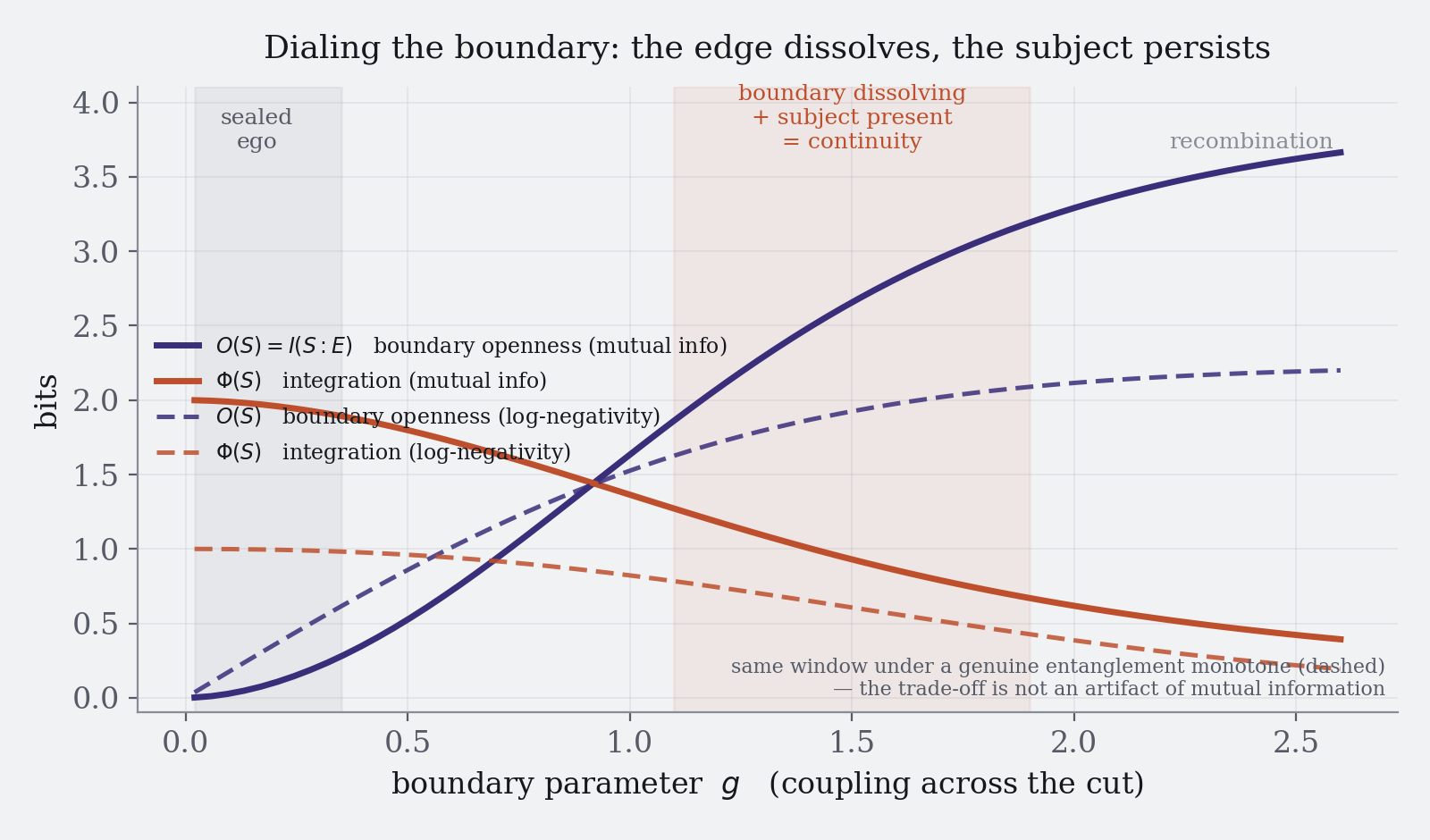
O(S) = I(S:E) rises from zero (a sealed ego) while the subject stays integrated through a continuity window, then, pushed toward full dissolution, integration finally erodes (the recombination limit).The computation clarifies a point that is easy to get backwards: continuity is not O(S) → 0 (that is a sealed subject) but rising O(S), the edge thinning, with integration preserved. The model also reveals something it was not built to show: opening the boundary drains the subject’s interior, so boundary openness and integration trade off. The driver is the bounded correlation budget of a finite, globally pure state. And the trade-off is no artifact of using mutual information: re-run the sweep with a genuine entanglement monotone (the logarithmic negativity) and the same window reappears. Lucid unity is therefore a narrow window, and a stronger interior (higher J_S) widens it, letting the boundary dissolve further before the subject comes apart.
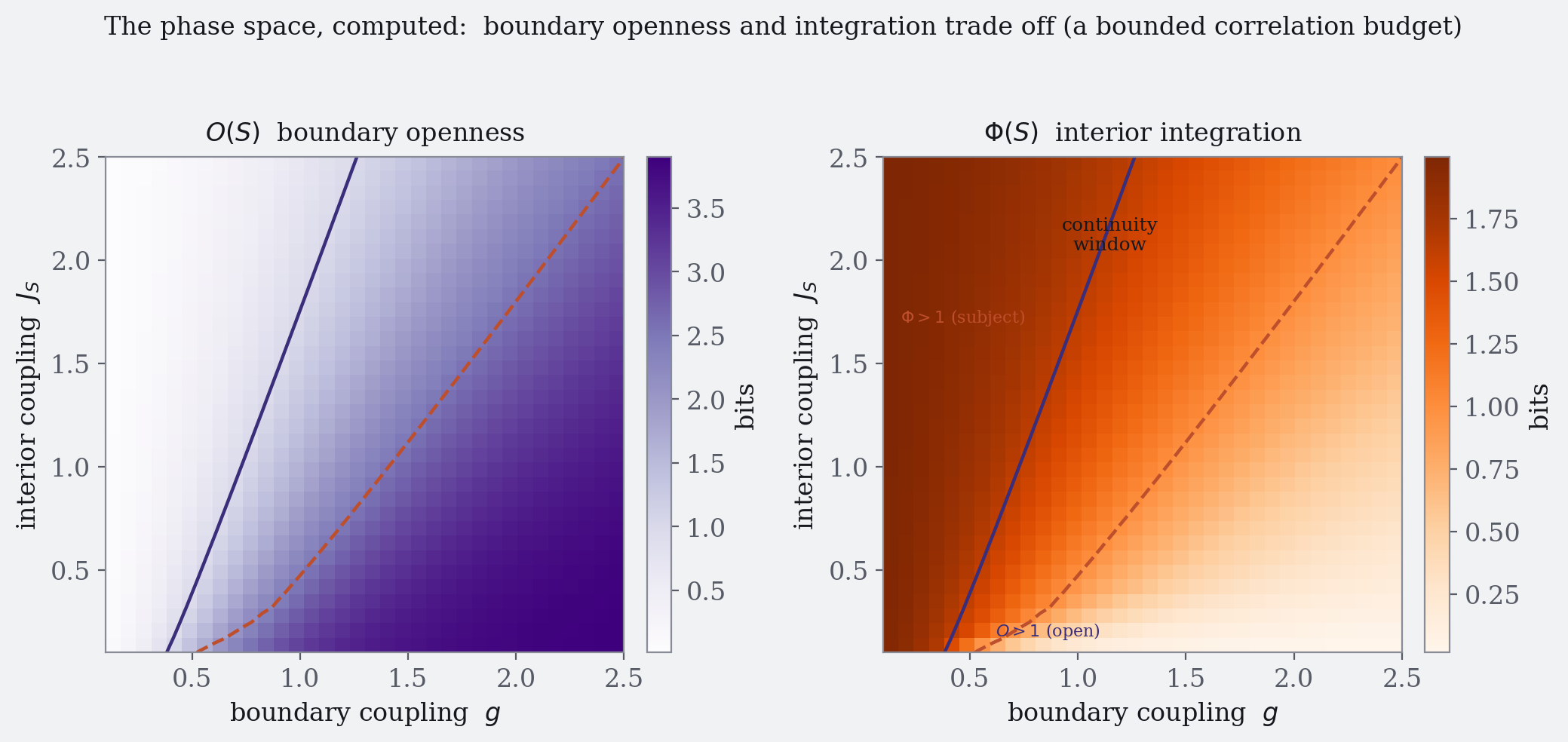
O>1) yet subject present (Φ>1), is the continuity window, and it widens with interior integration.So even a minimal model turns the central mechanism from metaphor into calculation, and yields a fresh, falsifiable prediction: greater interior integration should permit deeper boundary-dissolution before the subject comes apart. The limit is unchanged: the model demonstrates the structural claims, the boundary and the merging and the conditions for a unified subject, but produces no felt quality. It tests the physics of the parsing. Whether an interior simply is experience is a separate question, and the model cannot touch it.
This toy has a subject but no space. A follow-on build gives it one: a single free-fermion state from which an approximate geometry and a compact, integrated module are read off the same entanglement — and the regions that make good modules turn out to be the compact patches of the recovered space. It supports the picture's structural plausibility without deriving consciousness or emergent spacetime. One cut, two consequences → the build supplement.
III.2 · The limits
What is grounded, and what is not
The emergence of space and time from entanglement draws on real but still-unsettled physics. Everything downstream of the experiential identification rests on coherence rather than equations, and several joints are open and named rather than hidden:
- The selection principle is a conjecture. If minimal non-locality does not pick the realized factorization, emergent spacetime and decombination both fail.
- The new formalisms are themselves contested. Swapping integrated information for the free-energy / Markov-blanket picture trades one disputed framework for a less disputed but still-criticized one; it is a hedge, not a proof.
- The isomorphism is a structural bridge, not an identity of scale. It avoids the decoherence objection by relying on the substrate-level inversion to carry the identity claim, and the falsifiable prediction depends on it too: the bending-window interaction is derived at substrate scale, so it binds the brain only if the same integration–boundary trade-off survives the jump to neural dynamics, and the experiment tests that bridge as much as the claim it carries.
- The interior is asserted, not derived. No formalism yet takes a physical state and outputs what it is like to be that state (the hard problem, the central unsolved problem), and the related binding problem stays open.
- The veridicality gap is untouched. Even a clean experimental sweep would show only that felt continuity is the inside of a structural transition, not that the apprehended oneness reflects the real ground.
The toy model does not remove the mysteries, but it turns a vague claim into a sharp prediction that could fail.
References
Further reading
Linked references are general background, not endorsements of the theory’s specific claims.
- Hilbert space
- Tensor product of Hilbert spaces
- Quantum mutual information
- Quantum decoherence
- Quantum mind & the decoherence critique
- Ryu–Takayanagi conjecture
- Holographic principle
- Markov blanket
- Free energy principle
- Conatus (Spinoza)
- Integrated information theory
- Scale-free networks
- Critical brain hypothesis
- Default mode network
- Perturbational complexity index
- Lempel–Ziv complexity
- Hard problem of consciousness
- Panpsychism & the combination problem
- Falsifiability
Elsewhere in the series
The Weave and the Window
The plain-language picture: reality as one weave of connection, parsed by a finite point of view, and communion as what that connection is like from the inside.
Part III · The empirical companionThe Window
The single experiment whose result separates this theory from the deflationary account, built on the very interaction the toy model here derives.
Part IV · The phenomenological companionThe Return
The near-death experience as the one natural experiment in re-parsing, corroborating the shape, conceding the floor.
Part V · The philosophical companionThe Company It Keeps
The thinkers this picture converges with, Bohm, Whitehead, Huxley, German idealism, Schopenhauer, Teilhard, Hoffman, the closest living view in Kastrup’s idealism, and the one disagreement, with Jung, worth keeping sharp.